I feel that belief in God or a supreme authority has been necessary in Western world. This comes from my contemplation over the state of judiciary in the US. While on one hand, I felt it is very powerful (which is good) on the other, I found that there is very little justification for their existence, that is presented by laws themselves.
Circumventing laws, overriding the very intent why laws were created, is so much rife everywhere. Laws and ethics are completely two different things. Laws can only reward and punish people; they really don't make sure that anything wrong does not happen, nor do they attempt to. Its left to people to think and introspect about their actions, the end goal being getting most rewards and least punishments. You don't have to obey laws to be good, nor is it ascertained that if you are good in your own way you are going to be rewarded - what matters is how you appear in the eyes of the supreme.
Its one thing to obey the laws and its another thing to think of not thinking of harming someone. So, the intent is seldom under check. You can harm anyone if you want, but still be righteous in the eyes of others if you could circumvent the law. You can even fool God by gifting and giving. Everywhere, your own conscience is never under check by the laws. Laws and ethics are completly disconnected, which is certainly not desirable.
As an example, even if you know that your organization is doing some wrong activity (which you feel is not ethical) you can't publish it or tell it to others, because you are bound by something like a non-disclosure agreement. Submitting to the authority becomes more important than your own conscience. Honesty is upgraded to an organizational level, and addressing to honesty at personal level becomes less important than the one at higher (organizational) level.
But this disconnection of law and ethics is a serious void! How is this filled? Why doesn't this system crumble? The answer is the belief in supreme. The act of submitting to authority in the hope that your conscience is right, is exactly what the concept of 'God' is. I think it was a trade-off between such a void and unstablities of a system with no central authority, which made West fall back to its Greek-roman culture, admitting a bit of paganism, and relieving a bit of seriousness about believing in God a very Christian way. Still authority or God is a very important concept in the Western world, something central to at least the judiciary I know about.
Submitting yourself to the universal authority, preferring duty over the desire, is something that Christianity has imparted to the Western culture. Hence the 'concept' of God is key to such systems. If the belief in God is relieved, people would take the liberty (quite literally) of connecting the ethics to laws themselves. Something of this sort did happen in the times of Renaissance, whence the ideals of freedom and liberty came from. Again, it won't have been possible without the Greek-roman influence.
Not surprisingly, the concept of a modern democracy is due to a thinker who was criticized for his atheistic perversions, who contention was that the order of this world is decentralized, inherent in the whole creation. The metaphysics of God is inside every mind, and hence we, as human being are able to make our own choices, unbound by our own conceptions of God.
Wednesday, April 26, 2006
Thursday, April 20, 2006
Pessimism

I have repeatedly come to the conclusion that optimism is about a little bit of ignorance- not necessitated not inevitable, but a consciously chosen one. If you were really sure that you are going to succeed there would have been no need of that feeling what one calls optimism.
I can see that knowing too much about everything gives birth to pessimism and that it is inevitable: The real underlying problem is that you never actually know everything completely. You can only claim or believe that you know everything. The point where you think you've known everything, or realise that you know too much about everything, you see every thing as deterministic, doomed. Your own conclusions bear a lot of certainty, only in your mind. That is where pessimism begins from. Knowing too much, I think is highly likely to lead one into pessimism.
I can see that in my personal life as well. The people around me knowing very little about history, politics, philosophy are the happiest one, brimming with energy, and very much optimistic about life. Since they don't know, they don't predict, nor do they expect failure. Keeping on trying in hope of success is what an optimist does. Once you choose to think about the metaphysics of success and failure, you are bound to become at least a bit pessimistic...
I could go on talking about it, but thats all for now...


Thursday, March 16, 2006
In retrospect
Theorists say that there were many migrations in the period. A big invasion was not there. It makes sense too because it aint plausible that Aryans would ransack native (dravidian?) harrappan cities to go all the way down in order to clear forests and start a new 'civilisation'. Harappans are known to have traded with Egypt and mesopotamia-bactria. I won't be surprised if some people crossed the Indus for more 'opportunities'
The battle against AIT guys is more because of the search of Indian-pride than anything else. Just the way AIT was invented to establish the colonial superiority, those opposing the AIT with their rather 'strong' indological arguments, try to prove that most of what Indian culture became is because of stuff that existed in India, much before Aryans might have come. Aryans, like later migrators, didn't destroy it but got established in the pre-existent fabric. According to them, its wrong to say that Aryans were the ones who established Indian culture.
Consequently, sanskrit (something that is known to be literary "exclusively" in India) is not an "Aryan language" and niether are Vedas Aryan (although the sanskrit used in the latter might be different) For that matter, Vedas (in the literal sense) are considered eternal from a Hindu perspective. That is more like the semitic belief that scriptures have been handed over to human by God. It doesn't really matter, if Aryans dominated brahminhood for some time, or were the most ardent contributors to the eternal 'Vedas' (with the four they brought)
Well, AIT has really lost hold in academia. India still has it popular for the sole reason of its academia being dominated by the leftists.
The biggest blow to AIT, in my view was presence of Harappan sites on the erstwhile Saraswati river. Before that, everyone (esp leftist hist) rejected the R. saraswati as yet another disgusting Hindu belief. The drawings on large red pots used in their granaries, are now interpreted as representing some Puranic stories (Hindi: PaurANik). For example, the very belief of soul crossing the river Vaitarni before going to heaven, although present in Puranas is known to be of Greek origin. Since, we know that Harappans believed that and we know that its written in Puranas, there is really no reason to say that Aryans wrote Puranas.
That makes sense too, if you see that puranas or the classical upanisads don't express any spirit of nihilism. Its really hard to believe the big 'invasion'!
Besides, looking from the other side, there is another interesting set of theories that want to prove the preservation of pagan ways in the Roman Christianity that dominates the world. For example, there are a lot of similarities between the practices of Romans and North India's hindu (and I mean, nuu...merous!). Its sensational part kept aside, both civilizations might have shared ideas before Chrisitanity.
Saturday, March 11, 2006
indian double standards
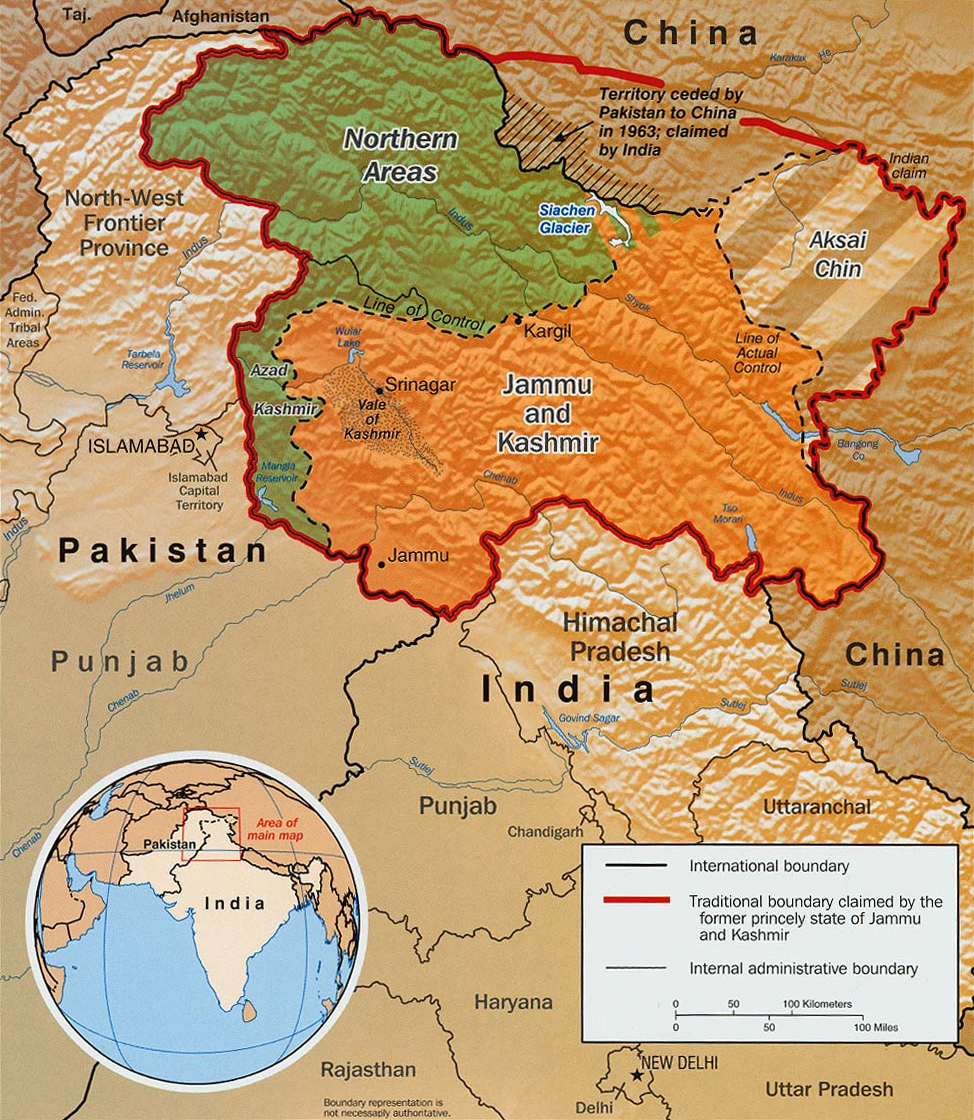
(image from Wikimedia)
when India considers creation of Pakistan to be the most fatal injury it suffered in her history, how can she concede to give away even an inch of a land to Pakistan so easily?
What india did in East Pakistan, might have been a scaled down version of what Pakistan is trying to do in Kashmir. (its a different story how bangladesh slowly became India's enemy too, as far as its political dominance goes) But then again, do we recognize Pakistan as a valid state at all? Most of Indians consider it a political mistake! Give'em a chance, and they want to declare it a terrorist state or something equally condemnable like that.
We (the hindustanis, at least) love the people of Pakistan, love their culture, but all that, at the same time makes us wish that partition shouldn't have happened. Does this feeling work against the recognition of Pakistan (which obviously, seems the only way to peace)?? A lot, I could say.
the question is- is there a middle path here? On one hand, we talk about building trust, opening borders, and then on the other hand, following the same peace argument, we are asked to give away another piece of land, making some more people suffer by leaving their homes, getting wiped off the map as a cultural entity?
Giving away Kashmir to Pakistan is obviously not the way. But since pundits have been made to leave the PoK anyways, why not just admit the LOC as international border, with only Kashmiris allowed to cross it.
But the fact is that, all this doesn't make any sense in pakistan. the spirit that drives pakistan constitutes the desire to absolutely eliminate kafirs (hindus, in this case) from the face of this earth. That, I think is exactly where the whole trust between Pakistan and India crumbles. Its impractical, even impossible to even think that there would be peace between these two countries, with Hindus thinking Muslims caused their downfall in history, and Muslims thinking that these Kali-worshipping baniyas need to be eliminated in the name of God. Kashmir has been the battleground for the imminent jehad.
And that is exactly why, IMHO the understanding and appreciation of each other's culture and religion is primary, not the Kashmir issue. Without the people's support, no political action can be justified. Kashmir might be the 'only' political issue, but I don't think politcal decisions should be taken without people's choice. I don't want to enact the British, deciding upon a country's boundaries without even thinking what people's culture is, and what their aspirations really are.
It might be another double standard not to hold the plebiscite, but the plebiscite frankly, doesnt make sense to India either. Heres why: Pakistan could always create a thousand Pakistans within India, following the same strategy, send military disguised as civilians - choose a bunch of uneducated poor youth - mindwash 'em with their own interpretation of the Holy book- and ask 'em to eliminate all pagans from Earth. We know Pakistan is good at it, and we really don't want that to happen all over India. Its not a double standard, its actually a move to preserve the "integrity", au contraire. (Remember that sleepy town Varanasi, the holiest of saivite places, where some freedom fighters brought some monkey-worshippers to justice, had 30% of Muslim population!! and that is a Hindu dominated region.)
I know that Pakistan thinks Kashmir never belonged to India, but from the understanding of Kashmiri culture India has, she thinks exactly the opposite. The idea of india, as an all-welcoming organic culture, is a direct antithesis to the radical hindu-hating nationalism in Paksitan. That should be the first settlement to be made.
Even if we give away the whole of Kashmir.. with the Mullahs rejoicing over their victory over Hindus, and the Hindus swearing the seculars who made a deal trading their motherland. You still have people hating each other, wanting to efface each other's people from the map of this world. I don't think its gonna stop after Kashmir. Pakistan may very well choose any other piece of India, and have a chance of creating another liberated land for Muslims, or even non-Muslims. Remember that Khalistan, that Pakistan just fell in love with? Obviously, we can't afford anything like that. Again no double standards involved.
Wednesday, March 01, 2006
Why I won't like The Corrs anymore

... and I feel like I once did probably more than 10 years back, when as a kid, my toy-cars and board-games had at once, lost their meaning. The things that would keep me involved for hours started sounding the most foolish things to do. The favorite music, the favorite TV shows, which were a bunch of cartoon shows and their songs, could not have me interested anymore. I could no more enjoy making silly things with paper and sticking them together to claim my magnum opus, although nothing more than a paper-crow or a wall-hanging.
However, its different this time. Back then, I was probably so excited in the new phase of my life, that I didn't feel like I had really lost something, although I probably did which I realise at this point. There was a whole new world for me, waiting for me to be taken over by. There was hope, and promise for me everywhere. Although as an illusion, the control that I had over things was worth living for.
I can't like the pleasant sound of Corrs anymore, and I don't feel good about it. I wish I could just stay the same, kept my belief in love, faith, interdependence, instead of this mean rationality. I wish I never needed to present the lame existential arguments, just to live on. My religion taught me that uncontrolled desire kills you, so did the other religion that late J C preached. I wish I could have just held onto that belief.
I know I am sounding like an existentialist again, but I actually don't take that seriously either. I never knew that such duality would take me over. On one of the trips to home to Varanasi, when I was reading Nirmal Verma on the reflections of West on East, I was praising my culture, for it gave no space to duality. But here I am, failed and jaded, victim of what they call the duality of man, seeing rationality both as a helper of humanity, and an enemy of emotions. Things would never be the same.
The denial of everything, leads to confusion, chaos, and exposure to all what could harm you. The introspection that follows, asserts individuality, and certain other non-existent base of emotions, that only keep you away from the truth. You seem to be drifting away in a direction that you never wanted. But there is little you could do about it either way.
When I don't like Corrs, or found them 'corny' I like Rammstein, death metal, music that supports killings and annihilation, so that nothing remains alive, because nothing is alive, in this world of wankers, where everyone is making deterministic moves in the matrix. You feel hurt and find that hurting is what is going on everywhere, just that there are few who realise it, but most don't, and they call this ignorance as happiness.
Choose one- go back to your beliefs, or just be drifting into the chasms of individual accompolishments. I can't really postpone this belief for so long. Is that where the idea of judgement day came from?
Subscribe to:
Posts (Atom)