Monday, December 04, 2006

Bergman


There is an old story of how the cathedral of Chartres was struck by lightning and burned to the ground. Then thousands of people came from all points of the compass, like a giant procession of ants, and together they began to rebuild the cathedral on its old site. They worked until the building was completed — master builders, artists, labourers, clowns, noblemen, priests, burghers. But they all remained anonymous, and no one knows to this day who built the cathedral of Chartres.

Regardless of my own beliefs and my own doubts, which are unimportant in this connection, it is my opinion that art lost its basic creative drive the moment it was separated from worship. It severed an umbilical cord and now lives its own sterile life, generating and degenerating itself. In former days the artist remained unknown and his work was to the glory of God. He lived and died without being more or less important than other artisans; 'eternal values,' 'immortality' and 'masterpiece' were terms not applicable in his case. The ability to create was a gift. In such a world flourished invulnerable assurance and natural humility. Today the individual has become the highest form and the greatest bane of artistic creation.

The smallest wound or pain of the ego is examined under a microscope as if it were of eternal importance. The artist considers his isolation, his subjectivity, his individualism almost holy. Thus we finally gather in one large pen, where we stand and bleat about our loneliness without listening to each other and without realizing that we are smothering each other to death. The individualists stare into each other's eyes and yet deny the existence of each other.
We walk in circles, so limited by our own anxieties that we can no longer distinguish between true and false, between the gangster's whim and the purest ideal. Thus if I am asked what I would like the general purpose of my films to be, I would reply that I want to be one of the artists in the cathedral on the great plain. I want to make a dragon's head, an angel, a devil — or perhaps a saint — out of stone. It does not matter which; it is the sense of satisfaction that counts.
Regardless of whether I believe or not, whether I am a Christian or not, I would play my part in the collective building of the cathedral.

----------------------------------------------------------

I want very much to tell, to talk about, the wholeness inside every human being. It's a strange thing that every human being has a sort of dignity or wholeness in him, and out of that develops relationships to other human beings, tensions, misunderstandings, tenderness, coming in contact, touching and being touched, the cutting off of a contact and what happens then.

----------------------------------------------------------

When film is not a document, it is dream. That is why Tarkovsky is the greatest of them all. He moves with such naturalness in the room of dreams. He doesn't explain. What should he explain anyhow? He is a spectator, capable of staging his visions in the most unwieldy but, in a way, the most willing of media. All my life I have hammered on the doors of the rooms in which he moves so naturally. Only a few times have I managed to creep inside. Most of my conscious efforts have ended in embarrassing failure...

----------------------------------------------------------

My basic view of things is — not to have any basic view of things. From having been exceedingly dogmatic, my views on life have gradually dissolved. They don't exist any longer... I've a strong impression that our world is about to go under. Our political systems are deeply compromised and have no further uses. Our social behavior patterns — interior and exterior — have proved a fiasco. The tragic thing is, we neither can nor want to, nor have the strength to alter course. It's too late for revolutions, and deep down inside ourselves we no longer even believe in their positive effects. Just around the corner an insect world is waiting for us — and one day it's going to roll in over our ultra-individualized existence. Otherwise I'm a respectable social democrat.

----------------------------------------------------------

To the fanatical believer physical and spiritual suffering is beside the point, compared with salvation. That is why, to him, everything happening around him is irrelevant, a mirror-image, a mere will-o'-the-wisp. ... I can really never get shot of them, the fanatics. Whether they appear as religious fanatics or vegetarian fanatics makes no odds. They're catastrophic people. These types whose whole cast of mind as it were looks beyond mere human beings toward some unknown goal. The terrible thing is the great power they often wield over their fellow human beings. Apart from the fact that I believe they suffer like the very devil, I've no sympathy for them.

----------------------------------------------------------

People think there's a solution... If everything is distributed in the proper quarters, put into the right pigeonholes, everything will be fine. But I'm not so sure. ... Nothing, absolutely nothing at all has emerged out of all these ideas of faith and scepticism, all these convulsions, these puffings and blowings. For many of my fellow human beings on the other hand, I'm aware that these problems still exist — and exist as a terrible reality. I hope this generation will be the last to live under the scourge of religious anxiety.

----------------------------------------------------------

I throw a spear into the darkness. That is intuition. Then I must send an army into the darkness to find the spear. That is intellect.
Saturday, December 02, 2006

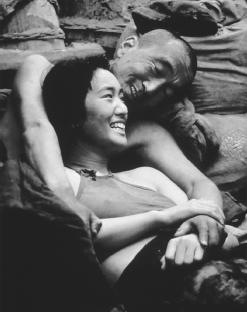
Ju Dou


Ju dou wasn't that great, but it belongs to the genre that Yimou experimented with in late 80s and 90s- tales of feudal china. It was good, but not as good as huozhe (to live) or raising-the-red-lantern. yimou is completely different in these movies, and his cinematography is the best in all of eastern cinema I have known.

The difference between raising the red lantern and flying-daggers would be 10 times more than that between Spielberg's Schindler's list and 'jurassic park-the lost world'. You can't always compare two such movies from the same director, not in such case of Yimou by any means.

Apparently Ju dou was banned in Chine because it was considered to have shown the lead female character rebelling against the male authority.

Tuesday, November 28, 2006

Must watch

This are the movies I have rated 5/5 on netflix, and I think, they all must be watched by anyone who ever loved movies :

(reverse alphabetical order)-

Yojimbo
X2: X-Men United
Wild Strawberries
White
The Virgin Spring
Umrao Jaan
Trainspotting: Collector's Edition
Trainspotting
To Live
Throne of Blood
The Three Stooges: Curly Classics
A Story of Floating Weeds
Star Wars: Episode VI: Return of the Jedi
Star Wars: Episode V: Empire Strikes Back
The Silence of the Lambs
The Shining
The Shawshank Redemption: Special Edition
The Seventh Seal
Seven Samurai
Schindler's List
Scarface
Run Lola Run
Rosemary's Baby
Roger Dodger
A River Runs Through It
Ridicule
Requiem for a Dream
The Red Violin
Red
Reality Bites
Rashomon
Raise the Red Lantern
Pulp Fiction
Psycho
The Pianist
Pi: Faith in Chaos
One Flew Over the Cuckoo's Nest
My Big Fat Greek Wedding
Mughal-E-Azam
Moulin Rouge
Moulin Rouge
Memento
The Matrix
LOTR: The Two Towers: Extended Ed.
LOTR: Return of the King: Extended Ed.
LOTR: Fellowship of the Ring: Extended Ed.
Lord of the Rings: The Two Towers
Lord of the Rings: The Return of the King
Lord of the Rings: Fellowship of the Ring
Jules and Jim
Human Nature
The Hours
The Good, the Bad and the Ugly
Good Will Hunting
Gol Maal
The Godfather, Part II
The Godfather
Girl, Interrupted
Ghost in the Shell
Full Metal Jacket
Forrest Gump
Fight Club
Fargo
Eyes Wide Shut
The Exorcist: Restored Version
The Exorcist
The English Patient
Driving Miss Daisy
Downfall
Donnie Darko: Director's Cut
Donnie Darko
Dial M for Murder
City of God
Cinema Paradiso: Director's Cut
Central Station
The Bridges of Madison County
Boys Don't Cry
Blue
The Big Lebowski
The Bicycle Thief
Ben-Hur: Collector's Edition
Ben-Hur
Bawarchi
Battleship Potemkin
Babette's Feast
Au Revoir Les Enfants
Andrei Rublev
Anand
Amores Perros
American Beauty
Almost Famous
All About My Mother
Adaptation
The 400 Blows

Monday, November 27, 2006

Songs

What folk music is... is based on myths and the Bible and plague and famine and all kinds of things like that which are nothing but mystery and you can see it in all the songs….All these songs about roses growing out of people’s brains and lovers who are really geese and swans that turn into angels…and seven years of this and eight years of that and it’s all really something that nobody can touch....(the songs) are not going to die.

- Bob Dylan.

Sunday, November 12, 2006

Through a glass Darkly

Bergman says it too. Believing in God is same as believing in love. If you can believe in love, you could rather believe in God as well. If by some rational explanation, God has to be completely ruled out, then by a similar reasoning there should be no reason for love either. A world without belief in God could be as dreadful to some as would be the world without any love, trust or friendship.

At the end of the movie, David asks his son, to stay calm and tells him that "God exists, because we all love Karin... Love is God! " We don't have anything to define our existence and so we have to pick up something and hold it to our heart. Whenever our holdings are gone, we pick something else up and hold that to ourselves. That is how we define ourselves - "Everything would be alright. Just keep faith in something".

I don't think anyone else can present existentialism better than the way Bergman does. He repeatedly makes me think that cinema is the best, most true, and most efficient form of art known to humanity.

Again, like in many other Bergman movies, I might not have understood all the connotations in the movie, including the title - Through a glass darkly, which is from a Biblical verse. In many of the dialogs there could be (and I am sure there were) allusions to Bible and some other writings, like a few by Dostoyevsky. Unfortunately, I am not too much aware of the literature that Bergman was expecting his viewers to be building the thoughts upon.

Nevertheless, the movie was terrific. It went boring for a while, especially the part after when the fact of protagonist's illness was known. But in around 20 minutes, the story picked up again and climaxed magnificently.

The performance by the protagonist was excellent. I don't know if anyone else could have done such a job. Harriet Anderson (Karin, in movie) suits very well to the character. Gunnar Bjornstrand played his role of the detached writer just perfectly.

The climax is magnificent, it rolls the whole movie into a few dialogs. All the chaos of the movie- Karin's pain, Minus's troubled juvenility and David's disconnection from it all, everything seems to survive just through faith - for faith is indeed such a powerful thing - the central theme of Bergman's movies.

Friday, November 03, 2006

Urdu Unicode definition file

Here is the Unicode keyboard definition for Urdu that I created to suite my intuition. I am sure this would be helpful for any Urdu/Hindi speaker who wants to write in Nastaliq. I would later write a key to help those who want to create a document in Nastaliq even if they don't know how to read nastaliq. Even better, I could write an ITRANS-> unicode converter at some point.

For now, just

i) download this file
ii) load the ukb file into Unipad or any other unicode text editor you may be using ( You can download Unipad from here)

and start using the keyboard.

اگلی پوسٹ تک کےلِیے الورہ


(good bye Until next post)

-created by entering the text "aglI posT tk kE lieY alvdO" in Unipad.

Thursday, November 02, 2006

Patrice Leconte


Patrice Leconte is one of those typical intellectuals who know how to show off their exceptional ability in the their profession. On one hand, we see this gentleman who is very well aware of his status as a movie-director, and on the other hand, he could portray himself as being doubtful about his own career by saying that he didn't want to be classified as the classicism director.

Nevertheless, his movies, classicism or not, have been one of the best I would've ever seen. My first Leconte movie was Le Mari de la coiffeuse, and it blew me away. It was one of the moments, that told me how appealing to emotions, cinema could possibly become. L'homme du train was not as exceptional, but it told a truth with a fatalistic perspective, that Leconte seems to like a lot.

Then I watched these two classicist movies - le veuve de st pierre and ridicule. It is almost a time-travel into the early modern France, watching his movies.