Showing posts with label reviews. Show all posts

Sunday, March 04, 2007

Flandres


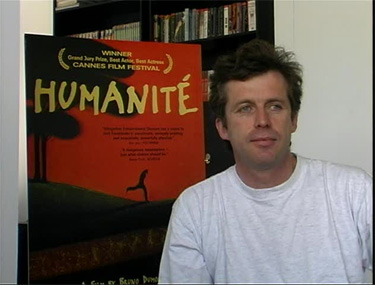
Came to know about Bruno Dumont in the 'Rendezvous with French cinema' organized in the Lincoln Center at New York. I am not aware of the current developments in French cinema, but this movie didn't seem to be an exceptional one. I didn't find the director to exceptionally good either that I would expect any better movies from him.

Like a typical on-stage conversation in performing arts, there were some questions and answers exchanged about the way director works, how much and what importance does he give to the script and so on - probably because of the abundance of budding movie-makers in the screening.

There is nothing much substantial in the movie that I could compare to the great movies I have watched in the past. There is thus very little I would recollect from the movie. Still one of the scenes would stay in memory for an interesting follow up. There is this scene in the movie which I didn't completely understand while watching it, where the woman raises up on her heels and the camera focuses on her from above. When Bruno was asked to explain this a little further, he mentioned that it is only the woman who is living within her body unlike the others in the movie. When rising up on her heels, she feels the whole exterior world in a resonating manner.

An interesting question that thus followed from one of the female audiences that why doesn't she herself feel anything like what Bruno said while watching the movie. Bruno's simple answer was that it is because he is a male, and she is a female. There are differences in the way we look at the universe and he completely admits that.

The memorable experience from this visit would be the Lincoln Center itself. This was one experience that I can connect really well to the screening of Rituporno's movies in Chowdiah memorial hall at Bangalore, India. Even though Bangalore never felt like New York, this was an experience similar in many ways. I walk into the building brimming with chitchats in a language I don't fully understand (Bangla/French). There is a strange unfamiliarity in the air which is somehow soothing because it serves as an escape from the world that surrounds it. I guess that is how it would be for any immigrant if he enters into such tents erected by other immigrants; those who don't belong here and have a world of their own that no outsider is welcome to, still they continue to share the inescapable common ground that belongs to everyone and yet it is no one's.

Saturday, December 02, 2006

Ju Dou


Ju dou wasn't that great, but it belongs to the genre that Yimou experimented with in late 80s and 90s- tales of feudal china. It was good, but not as good as huozhe (to live) or raising-the-red-lantern. yimou is completely different in these movies, and his cinematography is the best in all of eastern cinema I have known.

The difference between raising the red lantern and flying-daggers would be 10 times more than that between Spielberg's Schindler's list and 'jurassic park-the lost world'. You can't always compare two such movies from the same director, not in such case of Yimou by any means.

Apparently Ju dou was banned in Chine because it was considered to have shown the lead female character rebelling against the male authority.

Tuesday, November 28, 2006

Must watch

This are the movies I have rated 5/5 on netflix, and I think, they all must be watched by anyone who ever loved movies :

(reverse alphabetical order)-

Yojimbo
X2: X-Men United
Wild Strawberries
White
The Virgin Spring
Umrao Jaan
Trainspotting: Collector's Edition
Trainspotting
To Live
Throne of Blood
The Three Stooges: Curly Classics
A Story of Floating Weeds
Star Wars: Episode VI: Return of the Jedi
Star Wars: Episode V: Empire Strikes Back
The Silence of the Lambs
The Shining
The Shawshank Redemption: Special Edition
The Seventh Seal
Seven Samurai
Schindler's List
Scarface
Run Lola Run
Rosemary's Baby
Roger Dodger
A River Runs Through It
Ridicule
Requiem for a Dream
The Red Violin
Red
Reality Bites
Rashomon
Raise the Red Lantern
Pulp Fiction
Psycho
The Pianist
Pi: Faith in Chaos
One Flew Over the Cuckoo's Nest
My Big Fat Greek Wedding
Mughal-E-Azam
Moulin Rouge
Moulin Rouge
Memento
The Matrix
LOTR: The Two Towers: Extended Ed.
LOTR: Return of the King: Extended Ed.
LOTR: Fellowship of the Ring: Extended Ed.
Lord of the Rings: The Two Towers
Lord of the Rings: The Return of the King
Lord of the Rings: Fellowship of the Ring
Jules and Jim
Human Nature
The Hours
The Good, the Bad and the Ugly
Good Will Hunting
Gol Maal
The Godfather, Part II
The Godfather
Girl, Interrupted
Ghost in the Shell
Full Metal Jacket
Forrest Gump
Fight Club
Fargo
Eyes Wide Shut
The Exorcist: Restored Version
The Exorcist
The English Patient
Driving Miss Daisy
Downfall
Donnie Darko: Director's Cut
Donnie Darko
Dial M for Murder
City of God
Cinema Paradiso: Director's Cut
Central Station
The Bridges of Madison County
Boys Don't Cry
Blue
The Big Lebowski
The Bicycle Thief
Ben-Hur: Collector's Edition
Ben-Hur
Bawarchi
Battleship Potemkin
Babette's Feast
Au Revoir Les Enfants
Andrei Rublev
Anand
Amores Perros
American Beauty
Almost Famous
All About My Mother
Adaptation
The 400 Blows

Sunday, November 12, 2006

Through a glass Darkly

Bergman says it too. Believing in God is same as believing in love. If you can believe in love, you could rather believe in God as well. If by some rational explanation, God has to be completely ruled out, then by a similar reasoning there should be no reason for love either. A world without belief in God could be as dreadful to some as would be the world without any love, trust or friendship.

At the end of the movie, David asks his son, to stay calm and tells him that "God exists, because we all love Karin... Love is God! " We don't have anything to define our existence and so we have to pick up something and hold it to our heart. Whenever our holdings are gone, we pick something else up and hold that to ourselves. That is how we define ourselves - "Everything would be alright. Just keep faith in something".

I don't think anyone else can present existentialism better than the way Bergman does. He repeatedly makes me think that cinema is the best, most true, and most efficient form of art known to humanity.

Again, like in many other Bergman movies, I might not have understood all the connotations in the movie, including the title - Through a glass darkly, which is from a Biblical verse. In many of the dialogs there could be (and I am sure there were) allusions to Bible and some other writings, like a few by Dostoyevsky. Unfortunately, I am not too much aware of the literature that Bergman was expecting his viewers to be building the thoughts upon.

Nevertheless, the movie was terrific. It went boring for a while, especially the part after when the fact of protagonist's illness was known. But in around 20 minutes, the story picked up again and climaxed magnificently.

The performance by the protagonist was excellent. I don't know if anyone else could have done such a job. Harriet Anderson (Karin, in movie) suits very well to the character. Gunnar Bjornstrand played his role of the detached writer just perfectly.

The climax is magnificent, it rolls the whole movie into a few dialogs. All the chaos of the movie- Karin's pain, Minus's troubled juvenility and David's disconnection from it all, everything seems to survive just through faith - for faith is indeed such a powerful thing - the central theme of Bergman's movies.

Thursday, November 02, 2006

Patrice Leconte


Patrice Leconte is one of those typical intellectuals who know how to show off their exceptional ability in the their profession. On one hand, we see this gentleman who is very well aware of his status as a movie-director, and on the other hand, he could portray himself as being doubtful about his own career by saying that he didn't want to be classified as the classicism director.

Nevertheless, his movies, classicism or not, have been one of the best I would've ever seen. My first Leconte movie was Le Mari de la coiffeuse, and it blew me away. It was one of the moments, that told me how appealing to emotions, cinema could possibly become. L'homme du train was not as exceptional, but it told a truth with a fatalistic perspective, that Leconte seems to like a lot.

Then I watched these two classicist movies - le veuve de st pierre and ridicule. It is almost a time-travel into the early modern France, watching his movies.

Tuesday, October 03, 2006

Sacrifice


Watched this movie by Tarkovsky, called Sacrifice. I have this movie in Swedish, with English subtitles; I have kinda gotten accustomed to the Swedish movies watching so much of Bergman.

The movie is typical Tarkovsky- excellent visuals with a deepening impact and We don’t expect anything less from Tarkovsky. The cinematography in his movies seems to exhibit much more the skill of a still photographer than that of a movie-maker. Right since when the movie starts, the stills are in the right place. Like any other of Tarkovsky's, stills speak a lot here, probably the most about the story. The serene lake, with little signs of human activity, have an overall gloomy effect, possibly due to the wrongs of the human intervention. The human acts never fit the nature in these depictions.

Nature has this mystic beauty which human beings at first seemed so fit (because this imagery is indeed so appealing) the part that Tarkovsky unveils to is usually very dark. Through the dark imagery, Tarkovsky highlights the failures of our civilization in surviving as a part of nature. To think of manipulating nature, appears to be an implicit and necessary anomaly through his movies.

My favorite pick among all his movies still continues to be the CTALKEP (Stalker). That movies was packed with everything that Tarkovsky has to offer us, with dialogues as pithy as they can get.

Sacrifice shows us this family that has a philosophizing and introspective member named Alexandro, who seems to voice what Tarkovsky himself could be thinking. The conversations with his family members depict the conflicts and dissents among Western culture. Alexandro is in search of truth; but at the same time, he rejects religion. The way things progress in the movie, after the outbreak of a war (whose particulars are not necessary, although this is supposed to be the third world war) the old man Alexandro falls back to religion, giving way to his emotions and beliefs over logical understanding, which would eventually result in irrational but unavoidable 'rituals'.

The essential conflict like always, is that of rationality and ritual. Fighting with himself, and lost in his dilemmas, Alexandro still fears God. He decides to sacrifice the kid in the family, and even performs the ritual union with the assumed witch (overcoming his rational self). In some mystic fashion, union with a woman, although apparently evil is always seen as a redemption, as a blessing-in-the-end. A comparison of the feminine and the mystic with Mother Mary is thus bound to occur.

Now here is a word on Cast, and hence of course, on women. But first off, Alexandro is done a splendid job. His dialogue delivery and expressions are impeccable. Women are not exceedingly beautiful, and they are not supposed to be. What they are made to appear in the movie are women of dinivity, with strong features that don't fit the norms of classic beauties. The whole effect is contributed by images of Russian saints (a very incompatible set of ideas with Communism). Russian religion and belief-system is an integral, probably central part of Tarkovsky’s cinema. This movie probably has been the best expression of that idea.

Like many of the art cinema, there is what I call the after-effect of this movie. You may not understand fully what was going while watching the movie. But after you’re done watched the movie (fully) and back-reference it to various themes in your mind, you seem to understand how great the movie was, and you even may want to watch it again so as to really confirm that you didn’t miss anything that could have helped connecting the dots better. Of course, if you have visuals of this deep an impact the whole experience is worth re-experiencing.


No other art can fix time except cinema; Time we have lived is settled in our soul in and the experience is placed within time. Present slips acquires material weight...

- Tarkovsky


How time is turned back is what he wants to imply through this movie.


Sometime, I would want to know what exactly went on with personal life of Tarkovsky, so that I may understand what eventually drove him to such a dismal rejection of the progress of mankind. As a person, Tarkovsky is like me and probably like Bergman, he has emotional recalls but not exact recollections of memory.

Virgin Spring


Source: Wikimedia

It is rarely when a work like this surfaces in the world of cinema. Bergman's imagery is just amazing starred by the excellent performances especially the one by Ingari.

Most people I talked to about this movie, see it as one that inspired a similar hollywood movie. However, there is indeed much more to the story of Virgin Spring. Bergman's way of presenting existentialism, his depiction of conflicts between paganism and Christianity on which the movie is primarily based upon, is truly amazing.

The story of Virgin spring, is taken from an actual ballad about a spring that appeared on the spot where the virgin had died.

It only rarely that such dialectics of philosophy are expressed with so much clarity in cinema. That justice is ultimately His and that the mortals are bound to be sinful could not be explained in a better fashion.

Taking a note on cinematography, the cinema art seemed to have learned a lot from Kurosawa at the time this movie was made. In Rashomon, similar camera movements and characterization are used to exhibit the dilemmas and confusions of mankind. When human beings try to separate right from wrong and good from bad, it becomes hard to judge some everything. In both the movies, the classification of right and wrong doesn't seem to be always so sharply clear- Virgin Spring tells a very similar story only in a different culture, using different set of morals, ideas and values.

Bergman is one of those few directors who have mastered cinematography beyond what anyone can even dream of. In his own words, "cinematography is the only art that can present things as close to the ones in our dreams". This movie then, should be dreadful, yet a sublime and profound dream.

Since the very beginning of the movie, ingari worshiping a pagan god (Odin) is seen in pain - a very dark depiction of Ingari, indeed. Ingari seems to be possessed by the evil forces. A very significant part of the movie, thus, is about how intensely the evil takes her over. The end of the movie is when she seeks repentance.

Almost all of Bergman's movies are influenced by the Lutheran religion. Although he didn't practice religion as an adult, his childhood spent under stringent rules imposed by his parents (which he admits wasn't because of their malcontent or shortcomings as parents) ingrained religion in his way of thinking ; that in itself could be a very simple way to understand existentialism.

Sunday, July 16, 2006

Junoon - almost a legend


Not active so much any more, but Junoon was indeed a phase in the lives of all of us who grew up at the end of last millenium.

Their journey into music is quite amusing. The Junoon would have been just another college rock band, trying to impress the college chicks, imitating their favorites icons from 60s and 70s, going hippy, and just enjoying with the target crowd of college-going pakistanis. But it was only when they started experimenting with the sufi music that they could reach the masses, crossing the boundaries of countries and ethnicities. It was all due to Brian, may be, if he hadn't unified the other guys, the band would have never become the phenomenon that it eventually became.

The innovation into the music was nothing spectacular, at least in terms of the musical rhetorics. The sufi music is well established in South Asia, just the way Rock is in the whole of West. A band made of college goers who had the usual dreams of getting to become the next led zep or guns and roses, aimed to express the soul of Pakistani music with all what they had. This was not to be encouraged too much in the islamist country they hailed from. But still the music clicked. With the rhythms in the harmonics of tabla, the deep and polished voice of ali azmat, and the really impressive bass lines by Brian, the band was ready to hit a huge market otherwise dominated by cheap Indian music that should be appropriately considered devoid of any art at all.

It wasn't hard for Junoon to get popular in India. The reasons were simple. There is and never was any rock scene in India. All the rock bands localized among the elites of big cities, popular not even in all the colleges of the city they were in. Rock in India, like in most of South Asia, was never about anti-establishment and world peace, or about ideal of freedom of human soul. Rock in india is yet another commodity imported from West, which neo-rich people show off to serve their elitist snobbery.

The mind of youth seeks escape from the norms of the world, and it found its expression in Junoon. The Junoon had expressed something as traditional and mystified as sufi music with western means, something that symbolically represented what the minds of those in the colonies are always trying to accompolish.

I haven't been so much of an ardent fan of Junoon, even though it remains a fact that the only reason I took up the task of reading Nastaliq script was because I was having trouble looking up for some of the lyrics of their song, and was really disappointed at the way the available lyrics were transliterated into Roman script. Transliterations or translations really don't help too much when you wish to feel the spirit of a language or a country and its people. That was my personal infatuation with Junoon. Once I felt what they meant, I knew that nothing what they said could be limited by countries and religions.

Monday, July 03, 2006

Woody Allen


Probably its only because of my stay in the US, I have started liking Woody Allen way too much. His cinema might not have transcended boundaries of this country, to get the acclaim that some more profound directors have got. But his movies make so much sense here, mirroring the American life as beautifully as possible.

Now his movies are not like most Americans actually watch. His movies are those art-movies, the ones an average American would watch once every ten movies or so. Not quite unexpectedly, Woody Allen has been heavily influenced by European cinema instead. The characters in his movies, though carved out sharply in the script, are not so much of an imagined portrait of someone you hadn't seen yet. His characters are not exceedingly different from the ones in our daily lives either... and that is probably why neither does one have to have the taste of art-cinema, nor does anyone even need to relate some complex idealism to reality in order to comprehend Allen's existentialism.

The most profound of things could have been said with a sense of humor in his movies. The dialogues and the actions in the movie like you would expect, are just as natural as what you see in the people from everyday life.

I just finished watching melinda and melinda, and liked the movie. Its not really so much of a popular movie but I find it to be a powerful depiction of the Western life - the critical situations which individual desires bring you into, and the shimmering relationships that try to address them. The whole movie, like a good fiction, is so fluid and so gripping, that it becomes an emotional experience in itself. You can't avoid starting to ponder over your own life, while thinking about what you could possibly do to help melinda.

Friday, August 26, 2005

Nostalghia

My conscience wants vegetarianism to win over the world. And my subconscious is yearning for a piece of juicy meat. But what do I want?

Sunday, January 23, 2005

Raincoat - a review

Raincoat was such a disappointment to me.

Here is a small review of the 'latest' hindi movie I watched:

First of all, I am sorry that the great director's first work in Hindi cinema is not quite upto the mark. I watched 5-6 movies by rituporno (starting from unishe april to this one) and this one turned out to be the crappiest one. I personally would have liked this to be a play rather than a movie. A movie-screenplay with dialogue between two people going on for such a long time could have been worked upon. (But then, I am not considering the fact of reaching a limited audience with theatre in India.)

The bong way of looking at Hindi is one which regards Hindi as the language of biharis; This, like in most of his other works, is adequately expressed in the movie ('such' characters do speak hindi in his bengali movies) In the movie, since aish and devgan are from Darbhanga (a place in Bihar), their language has to be Hindi. But I don't think aish can ever appreciate that. Annu kapoor has taken the required accent and air quite appropriately. Devgan is matured, but one can only dream that Aish would become an actress, some day.

The following description has spoilers:

Like it is with most artists from the Kali-worshipping Bengal, the protagonists gotta be female[;)] This movie presents dreams and wishes of a girl, brought up in an environment where marrying a rich guy is the only way to have 'em materialized. What follows in the movie is a shattered dream, and horrors in a house-wife born out of disconnection from the real world. Aish iterates her fear of 'bathroom mein qaed ho jana'. Her drawing room is full of antique furniture that doesn’t belong to her. Her reality, is not about being 'a rich woman', something that she wanted to be as a young woman, something that she still wants everyone to believe, even her first-love. Her reality instead limits herself to a bathroom, which she is fearful of getting locked in (reason why she won't go in an airplane)

But then, devgans got his share too, although less highlighted. This is not the movie where young-man's frustration would be vented out the usual Hindi cinema way. Devgan, is weak, failed, and jaded. (He is found weeping in bathroom in the movie.) He gives up to emotions, and so, carrying impact of his failed first-love, he is presented as someone who needs support.


The climax of the movie takes off from O Henry's ' gift of magi' (Henry is thankfully mentioned in the credits). Raincoat is the carrier of gifts that the one-time lovers gave to each other, both pretending to be able to afford the gift. Raincoat, indeed, has its symbolism. Rituporno's overall idea of the movie is good, but he has not been able to convert it to a good movie. No one can attribute this to a language/culture barrier. Best of the best Hindi movies were directed by bongs afterall ;)

This movie is not for you if you think that Hindi movies shouldn't be doing anything except Shaadi-vaala band baaja, having nice time with the family-members visiting India, hoggin' and dancin' in big groups etc. This director is not subhash ghai or some chopra-vopra; He is an artist and he thinks his work ought to be reflective.

At last, two things:

1. I am not 100% sure that aish has become rituporno's muse or something. Can anyone enlighten me?
2. The mumbai - crowd I watched the movie with, suggested the movie should have been called bathroom. Whats your say?